
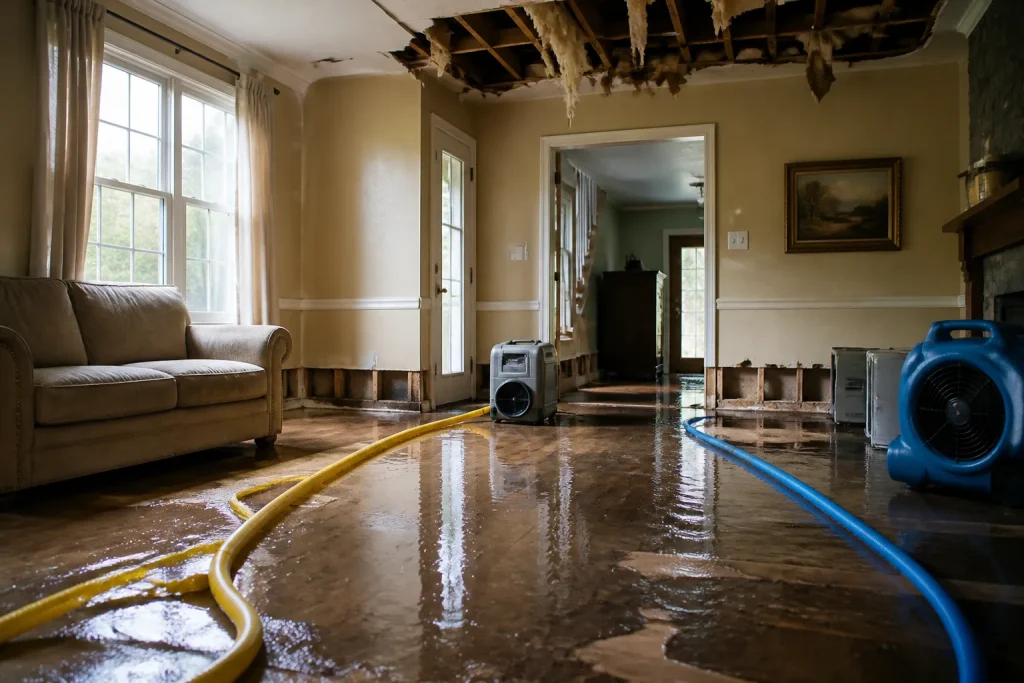
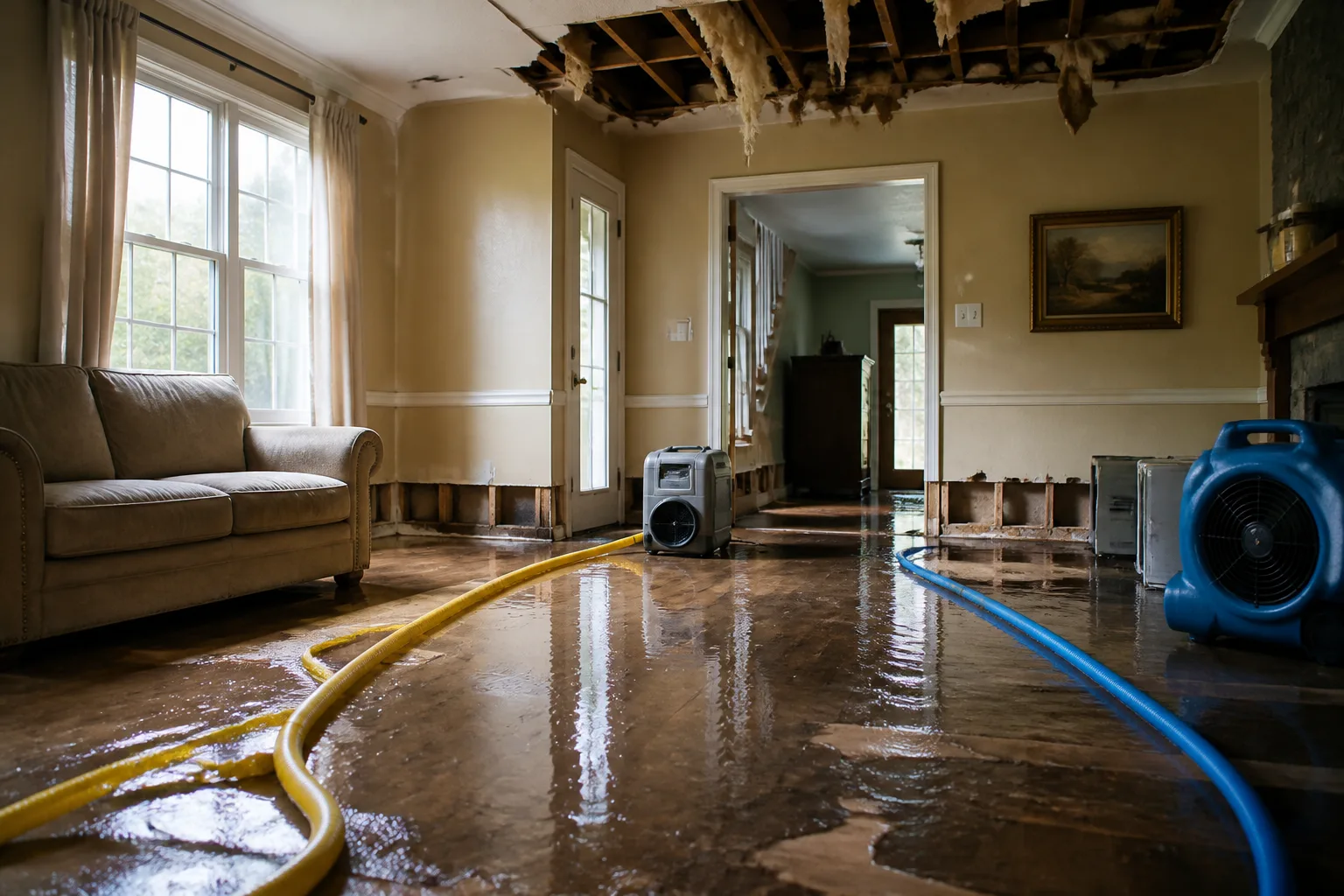
Emergency Water Damage Restoration Near Me: What Atlanta Homeowners Should Do First
When a pipe bursts or a water heater lets go in the middle of the night, the first hour matters more than most people realize. The biggest mistake Atlanta homeowners make is waiting until morning to deal with standing water, thinking an extra few hours won’t change much. It will. Water wicks up drywall at roughly an inch per hour, and mold can take hold in as little as 24 to 48 hours in our humidity. If you’d rather skip the reading and get someone on the phone right now, call (888) 690-3757 and Wade will answer.
What Actually Happens in the First 60 Minutes
Water doesn’t just sit where it landed. It moves. It follows gravity, sure, but it also travels sideways through drywall, under baseboards, and along floor joists in ways you can’t see from the surface. That’s the surprising part most homeowners get wrong: the water you can see is rarely the whole problem. We’ve walked into Atlanta homes where a small puddle near a bathroom vanity turned out to have soaked the subfloor across two rooms because it ran along the joists before pooling somewhere else entirely.
Here’s what happens in that first hour:
- Drywall starts soaking up water from the bottom edge, wicking upward like a paper towel in a glass.
- Laminate flooring begins swelling at the seams. Once it swells, it’s done.
- Carpet pad acts like a sponge and holds water against the subfloor even after the surface looks dry.
- Baseboards trap moisture behind them, creating a perfect little greenhouse for mold.
- Any wood furniture legs sitting in water start drawing moisture up into the piece itself.
The fastest thing you can do is cut the water source if you can find a shutoff valve safely. Then call someone who can actually extract the water. Not mop it. Extract it. In Atlanta, where summer humidity sits thick enough to chew, you don’t get a grace period. Wade heads out the moment you call, and he can have extraction running inside the hour. That’s not a promise we make lightly; it’s just what the equipment allows when you answer your own phone.
Five Things to Do Before Any Restoration Crew Arrives
You called. A crew is on the way. Now what? What you do in the gap between the phone call and the truck pulling up determines how much of your home gets saved. Here are the five moves that matter, in order.
- Stop the source if you can do it safely. Water heater, washing machine supply line, a burst pipe under a sink. Every appliance has a shutoff valve. If it’s a plumbing leak and you can’t find a fixture valve, shut off the main water line to the house. If water is anywhere near an outlet or panel, stay out of it and let the professional handle it.
- Kill the power to affected rooms, but only at the breaker. Don’t unplug anything standing in water. Flip breakers for the affected area. If the panel itself is wet, don’t touch it. That’s a job for an electrician.
- Move what you can lift without straining. Rugs, small furniture, boxes, anything on the floor. Lift it out of the water. Electronics on the floor are gone; leave them for the insurance claim.
- Prop up furniture on blocks or foil. Wood legs wick water. Rust from metal feet stains carpet. Blocks of wood, plastic cups, stacked foil work fine.
- Take photos of everything before anyone touches a thing. Not after. Before. Your adjuster needs to see the water line on the wall, the soaked carpet, the warped baseboard. You’re documenting the loss, not the cleanup.
We’ve had people in places like Buckhead and Decatur tell us they felt silly taking pictures of a wet floor at 2 a.m. It’s not silly. It’s the difference between a claim that gets paid and one that gets argued. And if you’re dealing with insurance, Wade deals with your adjuster directly. You won’t be the one stuck relaying information between two sides, which is exactly where claims get mangled.
What Actually Needs to Be Removed vs. What Can Be Saved
This is where national outfits earn their reputation for overselling. Not everything that gets wet needs to be torn out. Some of it can be dried in place. And some of it genuinely needs to go. The honest answer depends on the material and how long it sat wet.
Usually removable and replaceable
- Carpet pad: Always replace. It’s a sponge and it never dries right. The carpet itself can sometimes be saved if it’s pulled, dried, and re-stretched within a day or two.
- Laminated flooring: Once those seams swell, the click-lock system is compromised. It can’t be reset.
- Swollen baseboards and wet insulation: Both trap moisture against framing. They go.
- Drywall that’s wicked more than a foot: You cut the bottom section and replace. No point negotiating with soggy gypsum.
Often salvageable
- Hardwood floors: If caught early and dried with the right equipment, most hardwood in Atlanta homes can be saved. It takes professional drying mats and patience, but it’s done all the time.
- Tile: Tile doesn’t care about water. The subfloor under it might, but the tile itself is fine.
- Solid wood furniture: Gets dried, sanded if needed, refinished. Usually salvable unless it’s been sitting in water for days.
- Subfloor and framing: Once water is extracted and airflow established, lumber dries surprisingly well. The key is getting air moving under and around it fast.
What frustrates us most is hearing from a homeowner who paid for full demo on a room that could have been dried in place. It happens in Atlanta more than you’d think. Wade hands you moisture readings every single day. You see the numbers coming down. Nobody has to take anyone’s word for anything, which is how it should be.
How Fast Does Mold Actually Happen in Atlanta?
Faster than you want it to. The common number thrown around is 24 to 48 hours for mold spores to germinate on damp materials, but in Atlanta that clock runs faster from roughly May through October. Our ambient humidity sits above 60 percent most summer days. That means building materials that get wet may never fully dry on their own, even with fans blowing and windows open. The water evaporates into air that’s already too wet to carry it away.
This is why the extraction part matters so much. You can’t dry a room with box fans and a dehumidifier from Home Depot when you’re fighting Atlanta humidity. Well, you can in the sense that the floor will eventually feel dry to the touch. But the materials behind the baseboard and under the flooring will still be damp, and that’s where mold starts. Give it a week and you’ll smell it before you see it. That’s when a simple water job turns into a Mold Remediation in Atlanta project, which costs more and takes longer.
We use Dri-Eaz and Phoenix equipment for a reason. These are the professional dehumidifiers and air movers that pull moisture out of structural materials, not just off the surface. The difference between a homeowner fan and a professional dehumidifier is the difference between drying the air and drying the house. Atlanta’s climate doesn’t give you much margin, so the equipment matters.
What to Expect from a Good Restoration Company - and How to Spot a Bad One
If you’ve been burned before, you know the drill. The national chain quotes one number on the phone, then the crew shows up and suddenly the number doubles. Or the scope creep starts: “Well, now that we’re in here, we’re also going to need to…” You’re exhausted, your floors are wet, and you just want it over. That’s when honest people get taken.
Here’s what a straight-dealing restoration company does differently:
- Puts the scope in writing before work starts. Not an estimate. A scope. What gets removed, what gets dried, what gets replaced, and what it costs. You sign it. Then work starts.
- Gives you moisture readings every day. Not just “we’re drying it.” Actual numbers from actual meters. At the end of the job, you should have a log showing daily readings trending down. We hand that to every homeowner, every job.
- Talks to your insurance adjuster directly. You should never be the intermediary between a contractor and an insurance company. The contractor and the adjuster should speak directly, walk the site together, and agree on the scope. That’s how claims move forward.
- Has a real person answering the phone. Not an answering service. Not a call center in another state. When you call Wade’s Restoration of Atlanta, you get Wade or someone who works directly with him, 24 hours a day, seven days a week. That includes 3 a.m. on a Sunday. Wade answers his own phone.
Ask any restoration company in Atlanta if they’ll give you a written scope before they start pulling baseboards. The answer tells you everything you need to know. If they hesitate, call us instead. No trip charge inside the county. Free second opinion on any written estimate. And if you’re a senior or veteran, there’s a 10 percent discount on the work, always.
The Insurance Conversation Nobody Prepares You For
Here’s the thing nobody tells you before your first water claim: the adjuster works for the insurance company, not for you. That doesn’t make them your enemy. Most adjusters we work with across Atlanta are decent people doing a hard job. But their job is to settle your claim for what the policy covers, and your policy language works against you in ways that aren’t obvious.
The words “sudden and accidental” appear in most policies. A burst pipe is covered. A slow leak that’s been seeping for two months behind a wall is usually denied because it’s considered a maintenance failure, not a sudden event. “Resulting damage” is covered. The failed pipe itself may not be. You’re dealing with language that was written by lawyers to be precise in ways that favor the insurer.
This is why having someone who knows restoration and speaks insurance fluently matters. Wade has been working with Atlanta adjusters since 2007. He knows what photos your adjuster needs, what documentation proves the loss, and how to present a scope so the claim moves instead of stalling. We don’t negotiate against your own policy; we document what happened and present it straight. Most claims that get denied or reduced get denied because of missing documentation, not because the damage wasn’t covered. Photo documentation, daily moisture logs, and a written scope from day one make it hard for anyone to argue about what was wet and what was done about it.
If your water damage came from a roof leak during one of our Atlanta thunderstorm seasons, that falls under Water Damage Restoration in Atlanta the same way a burst pipe does, but the insurance conversation is slightly different. Wind-driven rain and storm damage often have their own deductibles. Ask your agent, or ask us to walk through it with you.
When to Call a Pro and When You Can Handle It Yourself
A spilled cup of water on a tile floor is a towel job. A toilet that overflowed clean water onto a small bathroom floor that you catch immediately? You might be able to dry that with towels and a fan if there’s no carpet and no drywall wicking. That’s about where the DIY list ends.
If water traveled under baseboards, soaked into carpet, sat for more than a couple hours, or came from anything that isn’t clean (sewage backup, washing machine with dirty laundry, a flooded crawlspace), call a professional. The same goes for anything involving electrical outlets, HVAC ducting, or finished basements in Atlanta, where the moisture load is always higher than you think. Sewage and contaminated water carry pathogens; drying that yourself is a health risk, not a savings. That’s a biohazard concern and needs professional treatment, not a shop vac from the garage.
Related services in Atlanta: if water has been sitting long enough for mold to take hold, you’ll want to read about our approach to Mold Remediation in Atlanta. And if the water came from a structure fire or the fire department that put it out, the damage pattern is different and covered on our Fire & Smoke Damage Restoration in Atlanta page.
The Bottom Line
Water damage in Atlanta moves fast, and the decisions you make in the first hour dictate how much of your home gets saved. Shut the water off, kill the power safely, photograph everything, and get someone with professional extraction equipment on the way. You want a written scope before work starts, daily moisture readings you can see for yourself, and someone who deals with your adjuster directly. If you’re in Atlanta and need help, Wade’s Restoration of Atlanta home is here. Founder Wade Ferris started this company in 2007 and has been answering his own phone since day one. Free estimates. No trip charge inside the county. Call (888) 690-3757 and Wade will be there himself, not a crew you’ve never met.
Frequently Asked Questions
Wade answers his own phone, 24 hours a day, seven days a week, and can have extraction equipment running inside the hour for most Atlanta locations. If water is actively flowing, call before you do anything else. The sooner extraction starts, the less gets torn out.
Most standard homeowner policies cover sudden and accidental water damage like a burst pipe or a water heater failure. Slow leaks that ran for weeks are usually denied. What matters most is documentation: photos of the wet materials before cleanup, moisture logs during drying, and a written scope. Wade works directly with your adjuster so you don’t have to translate between contractor and insurance company.
Fans move air across wet surfaces, which helps in small, clean-water spills caught immediately. Professional restoration means water extraction first, then structural drying with dehumidifiers that pull moisture from inside walls and flooring. In Atlanta humidity, surfaces that feel dry are often still wet underneath. We’ve seen rooms dried with box fans that looked fine and tested damp behind the baseboard two weeks later.
You don’t have to. Wade deals with your insurance adjuster directly. He walks the site with them, presents the scope, and provides the documentation they need. You get to focus on your family and your house, not on negotiating claim language.
Written by Wade Ferris, Owner at Wade’s Restoration of Atlanta, serving Atlanta since 2007.
Need Damage Restoration Help?
Call Wade's Restoration of Atlanta - licensed & insured, here with fast after-hours help in Atlanta.
(888) 690-3757