
Injectidry Water Damage Restoration in Atlanta: A Homeowner’s Guide
Injectidry water damage restoration in Atlanta is a targeted structural drying method that forces warm, dry air into wall cavities, under flooring, and behind cabinetry where surface drying can’t reach. It’s not a cure-all. It only works if the person running the system takes daily moisture readings and adjusts the setup based on what those numbers show. Most homeowners in Atlanta have no way of knowing whether the crew in their house is actually doing that, and that gap is where mold starts.
We’re going to walk you through what Injectidry actually does, why Atlanta’s climate makes it trickier than most places, and the exact questions to ask so you’re not paying for equipment that’s just sitting there looking busy. If you’re dealing with water damage right now and don’t want to sort through all of this yourself, call (888) 690-3757 and Wade will talk you through it.
Key Takeaways
- Injectidry forces warm, dry air into hidden spaces like wall cavities and under flooring, not just across the surface.
- Daily moisture readings are non-negotiable. Without them, neither you nor your insurance adjuster can prove the drying actually worked.
- Atlanta’s summer humidity (June through September) slows evaporation and extends drying timelines. A legitimate crew accounts for this in writing.
- The single best question you can ask is: “Can I see today’s moisture readings?” The answer tells you nearly everything.
- Equipment without documentation is a rental, not a restoration.
What Injectidry Actually Does (Without the Jargon)
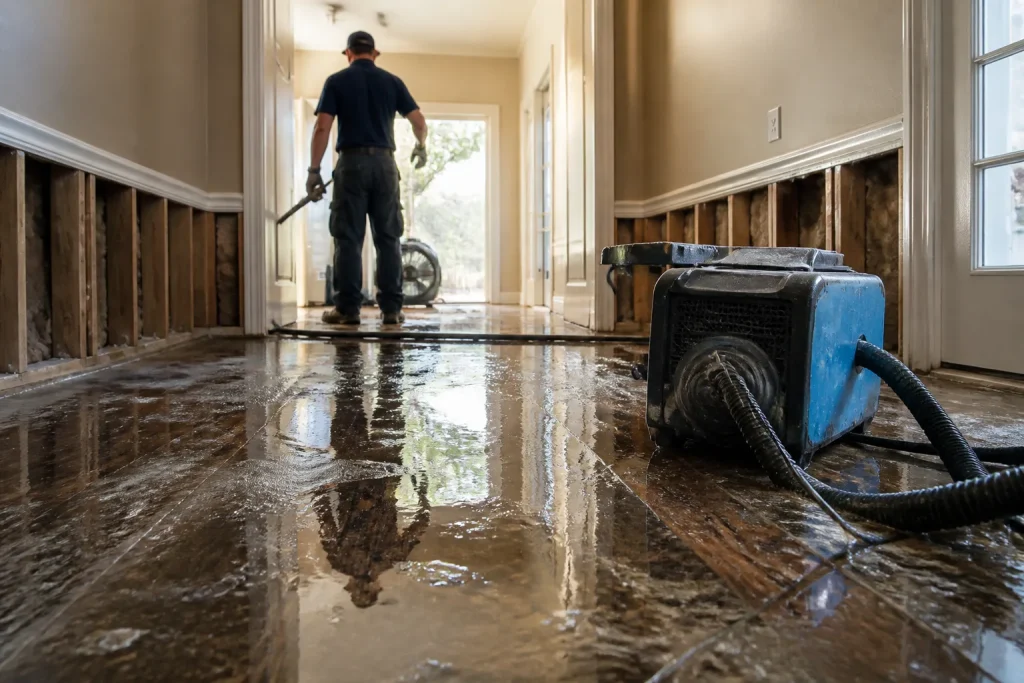
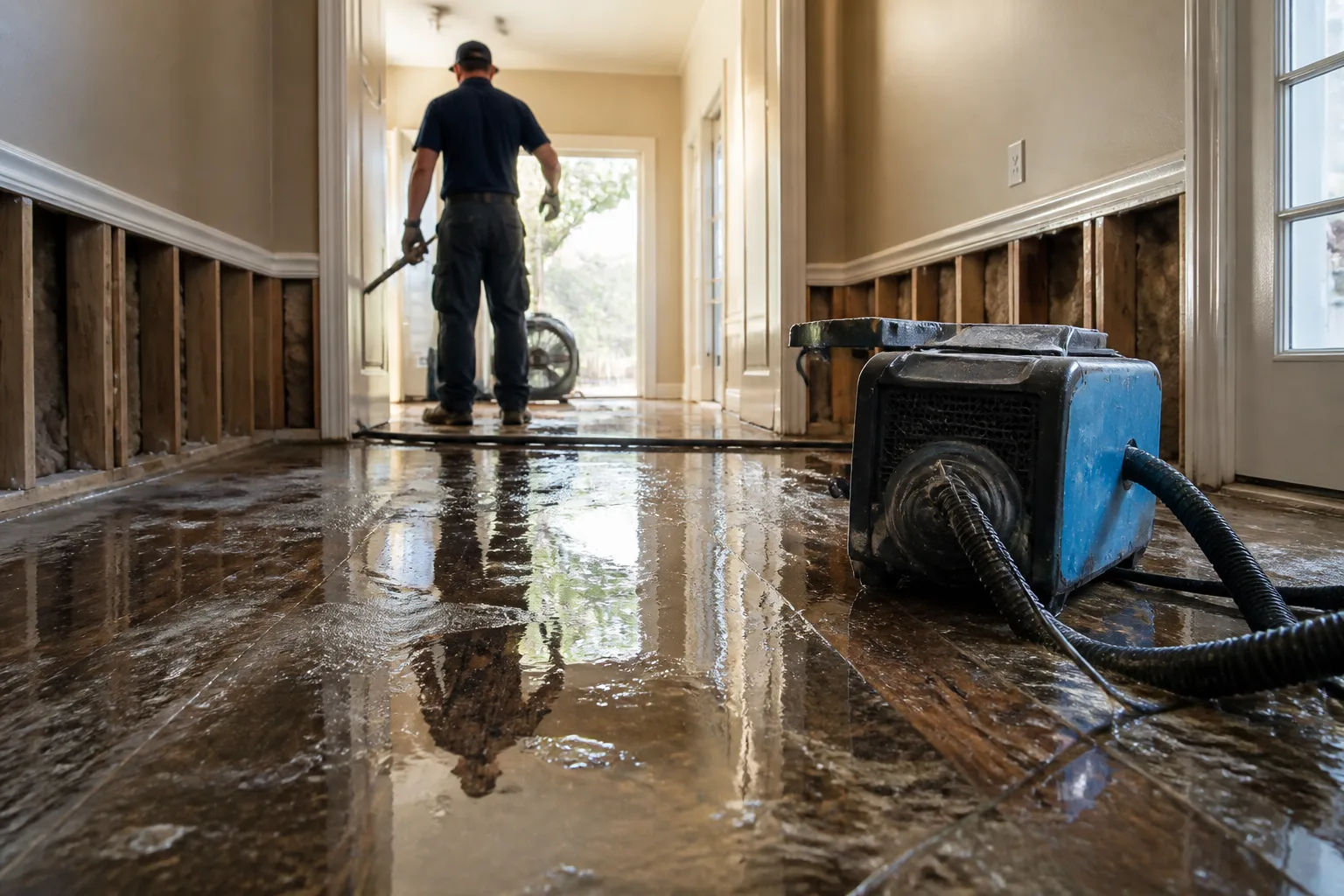
When water gets into your home, it doesn’t just sit on the surface. It travels. It wicks up drywall, seeps under vinyl plank flooring, and settles into the cavities between studs. A fan in the middle of the room moves air around, but it doesn’t reach inside those enclosed spaces. That’s the problem Injectidry solves.
The system uses a manifold connected to flexible hoses and small panels. Those panels attach to baseboards, cabinet toe-kicks, or drilled access points, and they push warmed, dehumidified air directly into the enclosed space. Think of it as a forced-air system for the inside of your walls. The warm air raises the temperature of the trapped moisture, turning it into vapor. That vapor then moves out through the airflow path and gets captured by the dehumidifier running in the room.
We’ve used Injectidry panels in homes throughout Atlanta, from Midtown bungalows with plaster walls to newer construction in Brookhaven where the builder used MDF baseboards that soak up water like a sponge. The equipment itself is solid. It’s the same professional-grade gear used by Water Damage Restoration in Atlanta crews who actually know how to read a moisture map. The problem isn’t the machine. It’s the operator.
Here’s what a proper Injectidry setup looks like in your home:
- Panels spaced every 8 to 12 feet along affected walls, not just one or two panels per room.
- Hoses routed cleanly against baseboards, not draped across walkways.
- Access holes drilled behind baseboards or in closets, never through visible wall surfaces in living areas.
- Dehumidifiers running continuously, with collection buckets or drain lines actively filling.
- A psychrometer on site taking readings at each panel location, not just once at the start.
If you walk into a room and see a couple of panels attached randomly with no visible dehumidifier running, that’s a red flag. The equipment is decoration at that point.
Why Atlanta’s Humidity Changes the Drying Math
Atlanta sits in a humid subtropical climate. From June through September, outdoor relative humidity regularly hits 80 percent or higher. That’s a problem because drying relies on a moisture gradient. Water vapor moves from wet materials to dry air. If the air outside is already saturated, the air inside your home has to work harder to absorb moisture from your walls and floors. Evaporation slows. Timelines stretch.
A competent restoration crew in Atlanta knows this and adjusts their drying plan accordingly. They don’t promise “three days and you’re done” in July. They might run the Injectidry system for five, six, or seven days because they’re chasing a target moisture content number, not a calendar. They also seal off the affected area with plastic containment so the dehumidifier isn’t fighting Atlanta’s outdoor humidity through an open window.
Here’s a real example. Last August we dried a kitchen in Virginia-Highland after a supply line burst. Three rooms affected, hardwood flooring, and the homeowner had a national franchise in first. They set three fans and a dehumidifier and left. Three days later the homeowner called us because the floor was still cupping. We pulled moisture readings: the subfloor was 27 percent. It needed to be under 12 percent. We set Injectidry panels under the flooring and inside the lower cabinets, and we took readings every day for a week. That flooring was saved. The national crew was going to let it cup and then tell her the floor needed replacing. That’s the difference between drying and pretending to dry.
Ask any crew working in Atlanta one question: “What’s your target moisture content for this material, and what’s the reading today?” If they can’t answer both numbers without flipping through papers, you have a problem.
The Moisture Log: Your Proof That Drying Actually Happened
Insurance adjusters don’t care how many fans were in your house. They care about documentation. When a claim gets denied or re-opened months later because mold appeared, it’s almost never because the equipment failed. It’s because nobody kept a moisture log proving the drying process worked. This is the single most overlooked part of water damage restoration in Atlanta, and it’s the difference between a closed claim and a yearlong fight.
Every day the system runs, a technician should be recording:
- Moisture content readings at each affected area, using a penetrating or non-penetrating meter, measured in percent wood moisture equivalent.
- Ambient temperature and relative humidity inside the contained drying zone.
- Grains per pound (GPP) of moisture in the air, which shows whether the dehumidifier is actually removing water.
- Equipment status, including which Injectidry panels are running and at what temperature.
- Daily adjustment notes: a panel moved, air flow redirected, a dehumidifier added or removed.
That log is what Wade hands to every homeowner at the end of a job. It’s yours. You paid for it. And it’s what your adjuster needs to sign off on the claim without bouncing it back for more review. The industry credentials behind this approach come from organizations like the IICRC and RIA, which set the standards for structural drying documentation. Any crew that can’t produce a daily log is not following those standards, no matter what their website says.
We’ve dealt with adjusters in Atlanta who tell us the homeowner called them daily worried the claim would be denied. The fix is always the same: send the moisture log. Once the adjuster sees daily readings trending down toward the target, they approve the drying portion and move on. No heated phone calls, no re-inspection delays. Just paperwork that does its job.
If your contractor looks confused when you ask for the log, that’s your signal to find someone else, fast.
Red Flags: Is the Injectidry Actually Working, or Just Taking Up Space?
The equipment doesn’t lie. The people running it sometimes do. In Atlanta, where humidity hides moisture problems until they become mold problems, you need to know what incorrect Injectidry use looks like. Here are the most common failures we see when we’re called in to fix someone else’s botched drying job:
Panels in the wrong places. Injectidry panels need to be positioned along the affected wall or floor line, with airflow directed into the actual wet cavity. If you see panels clustered in one corner while the visible water damage runs along the opposite wall, the crew didn’t map the moisture. They’re just making noise.
No psychrometric data. Psychrometrics is the science of air properties: temperature, humidity, grains per pound, dew point. Any legitimate structural drying job in Atlanta requires daily psychrometric readings. If no one ever measures the air, no one can prove the dehumidifier is lowering moisture levels. You’re paying for air movement, not drying.
Equipment pulled too early. The most common shortcut in the industry. The crew shows up, runs fans and panels for three or four days, declares victory, and packs up. But if the target moisture content for your hardwood subfloor is 12 percent and it’s still reading 16 percent, the water is still in there. Mold needs moisture, food, and time. Pulling equipment early leaves the moisture in place and gives mold the time it needs. We’ve seen this in homes across Atlanta, from Decatur to Sandy Springs, and the outcome is always a more expensive mold remediation job.
No written drying plan. Before equipment goes in, a professional crew should provide a written scope: what’s wet, how they’ll dry it, what target moisture content they’re aiming for, and an estimated timeline. If you get a verbal “we’ll have it dry in a few days” with nothing on paper, you’re gambling with your home.
The pattern here is simple: real Injectidry work is measured, documented, and adjusted daily. Fake Injectidry work is loud equipment and vague promises. In Atlanta’s climate, the difference shows up weeks later as a musty smell in the hallway.
The One Question That Separates Pros From Pretenders
You don’t need to become a water damage expert to protect your home. You need one question.
Walk up to the person running the job and ask: “Can I see today’s moisture readings?”
Watch what happens. A professional crew pulls out a tablet, a clipboard, or their phone and shows you the numbers. They can tell you what the reading was yesterday, what it is today, and what it needs to be before they pack up. They’ll point to the wall and show you where they took the reading. They’ll explain it in plain English because they know what they’re doing and the numbers back them up.
A crew that’s faking it stumbles. They say the “machine keeps the readings” or “the office has them.” They get defensive. They tell you not to worry about it. They might point to the equipment humming in the corner like that’s the same thing as proof.
That one moment tells you more than any review or any website. If they can’t show you today’s numbers, they’re not tracking them. And if they’re not tracking them, they’re guessing. You don’t want guesswork inside your walls in Atlanta, where humidity turns guesswork into mold.
Wade takes moisture readings every single day on every job and hands the homeowner the full log when the equipment comes out. No one has to ask. It’s just how the job is done. Ask around. Anyone who’s worked with Wade’s Restoration of Atlanta home will tell you the same thing.
When to Call a Pro (And When to Wait)
If you’ve had a pipe burst, a water heater fail, or a dishwasher supply line let go, don’t wait. Water migration starts within minutes. Within an hour, water has moved from the visible puddle into baseboards, under flooring, and up drywall seams. Within 24 hours, mold spores that were dormant find the moisture and start waking up. This is not a project for a shop vac and a box fan from the garage.
At the same time, you don’t need Injectidry for every wet spot. If you spilled a glass of water and wiped it up within a few minutes, you’re fine. If a small area of carpet got wet from tracked-in rainwater and dried on its own within a day, you’re probably fine. The line is this: if water sat against any building material for more than a couple of hours, or if the water came from anything other than clean tap water, call a professional.
Grey water from washing machines or dishwashers, and black water from sewage backups, are not DIY territory. The health risks from bacteria and pathogens are real. If you’re in that situation, call (888) 690-3757 and Wade will be on the road. He answers his own phone, night or day.
Related services in Atlanta: if water has already led to visible mold growth or that musty smell in the walls, read more about Mold Remediation in Atlanta. If you’re dealing with the aftermath of a fire and the water used to put it out, start with Fire & Smoke Damage Restoration in Atlanta.
The Bottom Line
Injectidry is a powerful structural drying system when it’s run by someone who understands moisture, takes daily readings, and adjusts the plan based on data rather than habit. In Atlanta’s humid climate, that documentation isn’t a nice-to-have. It’s what protects your home from mold, your wallet from a denied claim, and your family from living in a house that only looks dry.
The next time a crew is in your home running drying equipment, ask the question: “Can I see today’s moisture readings?” If they can’t show you, they’re not doing the job. If they can, you’re in good hands. Either way, you’ll know in five seconds.
If you’re in Atlanta and dealing with water damage right now, call (888) 690-3757. Wade’s Restoration of Atlanta offers free estimates, and Wade will tell you straight what you need and what you don’t. No pressure, no scare tactics. Just honest answers from someone who’s been doing this in Atlanta since 2007.
Frequently Asked Questions
Most Injectidry drying jobs in Atlanta take 3 to 7 days, but the timeline depends on the material, the amount of water, and the season. During Atlanta’s humid summer months, drying often takes a day or two longer because the outdoor air holds so much moisture. A legitimate crew sets a target moisture content number and keeps running equipment until the reading hits that number, not just for a set number of days. Call (888) 690-3757 for an honest timeline for your specific situation.
Most homeowner’s insurance policies in Atlanta cover structural drying as part of water damage mitigation, but the insurer typically requires documentation proving the drying was necessary and effective. Daily moisture logs are what adjusters look for. If the crew can’t produce those logs, the insurer may deny or reduce the drying portion of your claim. Wade deals with adjusters directly and hands you the full moisture log at the end of the job, so there’s documentation behind every dollar claimed.
Ask to see the daily moisture readings. A professional crew tracks moisture content at each affected area every day and can show you the numbers trending down toward the target. If the crew can’t show you readings, or if the numbers aren’t moving, the equipment is either set up wrong or the drying plan is failing. Anything less than daily, documented readings is guesswork, and guesswork in Atlanta’s humidity leads to mold. Call (888) 690-3757 if you suspect your drying job is off track.
Fans and dehumidifiers dry the surface and the open air. Injectidry forces warm, dry air into enclosed spaces like wall cavities, under flooring, and behind cabinets where surface drying can’t reach. If water has wicked into your walls or under your floors, fans alone won’t get it out, no matter how many are running. Injectidry targets the hidden moisture, which is where mold in Atlanta homes actually starts. The equipment only works as well as the technician’s moisture mapping, so choose a crew that takes daily readings.
Written by Wade Ferris, Owner at Wade’s Restoration of Atlanta, serving Atlanta since 2007.
Need Damage Restoration Help?
Call Wade's Restoration of Atlanta - licensed & insured, here with fast after-hours help in Atlanta.
(888) 690-3757