
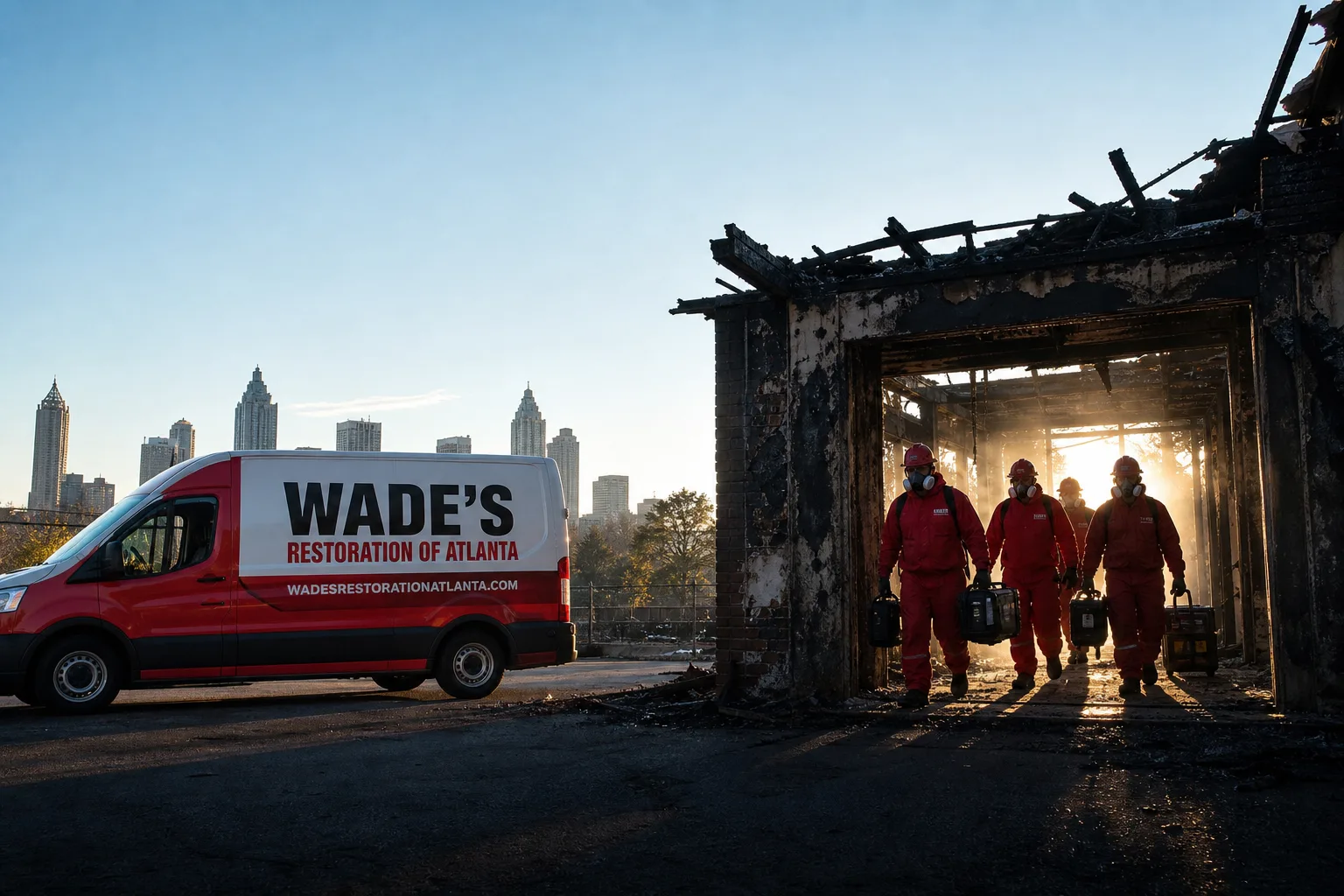
Emergency Storm & Disaster Restoration When Atlanta Homeowners Need It Most
Call (888) 690-3757 right now. We answer 24/7, and a live person picks up, not a voicemail tree. When a tree is through your roof in Decatur or a burst pipe is flooding a Kirkwood crawl space at 2 a.m., waiting until morning isn’t an option. Our crews are staged across metro Atlanta and can typically be on-site within 60 to 90 minutes of your call for 24 Hour Storm & Disaster Restoration in Atlanta, GA.
Why Atlanta Storms Hit Harder Than Most Cities
Atlanta’s identity as the “City in a Forest” isn’t just a nickname. We have one of the highest urban tree canopy coverages of any major U.S. city, and that canopy is both our beauty and our liability. Mature water oaks, loblolly pines, and sweet gums tower over rooftops in Grant Park, Inman Park, and dozens of older intown neighborhoods. When a summer thunderstorm rolls through with 50 mph gusts, or an ice storm coats limbs with a quarter-inch of glaze, those trees don’t bend. They break. And they land on houses. No other Southern metro sees storm restoration calls driven this heavily by falling trees and limbs.
Compounding that, Atlanta’s housing stock wasn’t built for hard freezes. Pipes run through uninsulated crawl spaces and unheated attics in homes from the 1910s Craftsman bungalows to the 1960s ranch houses of the near suburbs. When a freeze event hits like Snowjam in 2014 or the ice storms of 2021, it’s not one house with a burst pipe. It’s hundreds, across the whole metro, all at once. Restoration capacity evaporates overnight. Having a local team that already knows your neighborhood and your home’s construction type matters more than people realize until they need it.
Available 24/7 for Storm & Disaster Restoration Emergencies in Atlanta
What counts as an emergency? Water coming through your ceiling. A tree limb through a bedroom window. A sewage backup flooding a basement in Morningside. A broken pipe spraying water inside a wall cavity in a Sandy Springs kitchen. Any of these scenes means active water intrusion is happening right now, and every hour it continues, the damage compounds. Drywall wicks moisture upward. Hardwood floors cup and buckle. And in Atlanta’s climate, mold can begin colonizing wet organic materials in 48 to 72 hours.
Call (888) 690-3757 and you’ll get instructions from a real person on what to do while our crew is en route. If it’s safe to shut off water or electricity, we’ll walk you through it. If it’s not safe, we’ll tell you to stay out and wait. No upcharge for nights, weekends, or holidays. We don’t believe in penalizing people for having disasters at inconvenient hours.
Emergency Storm & Disaster Restoration We Handle in Atlanta
Most our Storm & Disaster Restoration services calls in metro Atlanta fall into a handful of categories. These are the ones we see week after week, and these are the ones that can’t wait:
- Fallen trees and large limbs through rooftops. A mature oak limb weighs hundreds of pounds. When it punctures a roof deck, it opens the structure to rain and leaves a hole that can’t be tarped from inside. We handle the emergency structural tarping, water extraction from the attic and ceilings below, and coordinate tree removal with licensed local arborists. This is the single most common summer storm call we get from neighborhoods like Grant Park and East Atlanta, where the canopy is densest.
- Burst pipes from hard freezes. Atlanta’s crawl-space plumbing means a hard freeze turns unprotected copper and PEX into time bombs. When the thaw comes, the leaks start, often inside walls where you can’t see them. We arrive with thermal imaging to find the leak source, stop the flow, and begin extraction immediately. Fast response here is the difference between a room repair and a whole-house mitigation job.
- Storm-driven water intrusion through roofs, windows, and foundations. Atlanta’s red clay soil drains poorly. Intense afternoon thunderstorms from April through September dump an inch or more in under an hour, and that water pools against foundation walls and seeps into crawl spaces. Repeated intrusion leads to chronic moisture problems and mold in crawl-space floor joists. If you see water in your crawl space after every heavy rain in Chamblee or Tucker, that’s not normal, and it’s not going to fix itself.
- Sewage backups and contaminated water events. Tree roots in Atlanta’s older sewer laterals plus torrential stormwater can overwhelm residential lines. Category 3 water contains bacteria and pathogens. This is not a DIY mop-up. We extract, sanitize, and remove affected porous materials to restore a safe environment.
Every one of these scenarios gets worse by the hour. Call (888) 690-3757 the moment you see water where it doesn’t belong.
Our Emergency Response Process
Step one: you call (888) 690-3757. A live dispatcher answers, asks a few quick questions about what you’re seeing, and dispatches the nearest available crew. Step two: our crew arrives, assesses the scene, and documents everything with photos before touching anything. That photo documentation matters if you’ll be filing an insurance claim. Step three: we stop the active intrusion. That means tarping a roof breach, shutting down a leak, or extracting standing water with truck-mounted units from Dri-Eaz and Phoenix. Step four: we set drying equipment and begin monitoring. Step five: we provide a written scope of the restoration work needed, in clear language, agreed before any reconstruction starts. You’ll never be surprised by work you didn’t approve.
Wade’s Restoration of Atlanta runs enough crews to roll a full response for single-family homes, multi-story buildings, and commercial spaces. When a city-wide freeze event hits, we scale up with additional equipment from our warehouse and bring in XPOWER air movers and dehumidifiers by the pallet. We’ve worked through every major storm event of the past decade as the Best Storm & Disaster Restoration in Atlanta, GA, and we know which suppliers have stock when the whole metro is scrambling.
Emergency Storm & Disaster Restoration Cost in Atlanta
Honest numbers for a high-stress situation. Most emergency storm restoration calls in Atlanta start with a free phone assessment, then a free on-site inspection. The work itself is typically billed against your insurance claim, and we work directly with your adjuster from day one. For non-insured water extraction, expect emergency response fees to run anywhere from $150 to $400 depending on time of night and location, with the bulk of the cost driven by the extent of water extraction and how many days of drying equipment are needed. We give you a written estimate before any paid work begins. No hidden line items. No surprise charges after the fact. Call (888) 690-3757 and ask us directly. You’ll get an answer, not a sales script.
Frequently Asked Questions - Emergency Storm & Disaster Restoration in Atlanta
In most cases, you’ll see our crew within 60 to 90 minutes of your call for Same Day Storm & Disaster Restoration in Atlanta, GA, depending on how far you are from the nearest available team and whether a city-wide storm event has every crew running at once. During a major freeze like 2021’s ice storm, demand spikes across the entire metro and response times stretch. Call (888) 690-3757 and we’ll give you a realistic ETA, not a promise we can’t keep.
Most homeowners policies in Georgia cover sudden and accidental water damage from storms, burst pipes, and wind-driven rain. Tree removal after a fall is often covered up to policy limits. We photograph everything before work begins and communicate directly with your adjuster, because a well-documented claim gets approved faster. We can help you understand your specific policy’s coverage during the initial call.
If it’s safe, shut off the water main if a pipe is leaking, or flip the breaker to an affected room if water is near electrical outlets. Move valuable items out of the water’s path if you can do so without risk. Don’t enter standing water in a flooded basement unless you’re certain the power is off. And don’t try to remove a fallen tree limb from a roof yourself. Wait for us, or for a tree professional we coordinate with. Call (888) 690-3757 if you’re unsure about anything.
If water stayed on the surface for under 24 hours and it’s a small, clean-water spill, you might get away with fans and a dehumidifier. But water that has soaked into drywall, subfloor, or crawl-space framing won’t dry thoroughly without commercial air movers and dehumidifiers. And in Atlanta’s summer humidity, a damp wall cavity or floor joist starts growing mold in two to three days. If the water came from a storm, a sewer backup, or a pipe that ran for hours, call (888) 690-3757 for a professional assessment before you decide.
We do. Wade’s Restoration of Atlanta has handled thousands of Atlanta-area insurance claims and we speak fluent adjuster. We document the damage with photos, write estimates in the exact format insurance companies expect, and meet adjusters on-site when needed. You hired us to restore your home. Handling the paperwork is part of that job.
Call for Emergency Storm & Disaster Restoration in Atlanta - We Answer 24/7
If water is coming in, a branch is on your roof, or you’re standing in a flooded crawl space in Decatur, Doraville, or anywhere in metro Atlanta, don’t wait. Call (888) 690-3757 now. A live person answers. A local crew gets dispatched. And you get a written plan before any work starts. We’ll be there fast.
Written by Wade Ferris, Owner at Wade’s Restoration of Atlanta, serving Atlanta since 2008.
What Our Customers Say
"He gave me the daily moisture log at the end, on paper, with the readings from every point. I have never had a trade prove the job was actually finished before."
- Rowena Thackeray"He talked me through what would happen next while I was still standing in the water crying down the phone at him. That was worth as much to me that night as the equipment."
- Delphine Aubrey"He photographed everything before he touched a thing and took moisture readings every single day, then handed the whole file to the adjuster. Our claim went through without one argument."
- Roosevelt Dandridge