
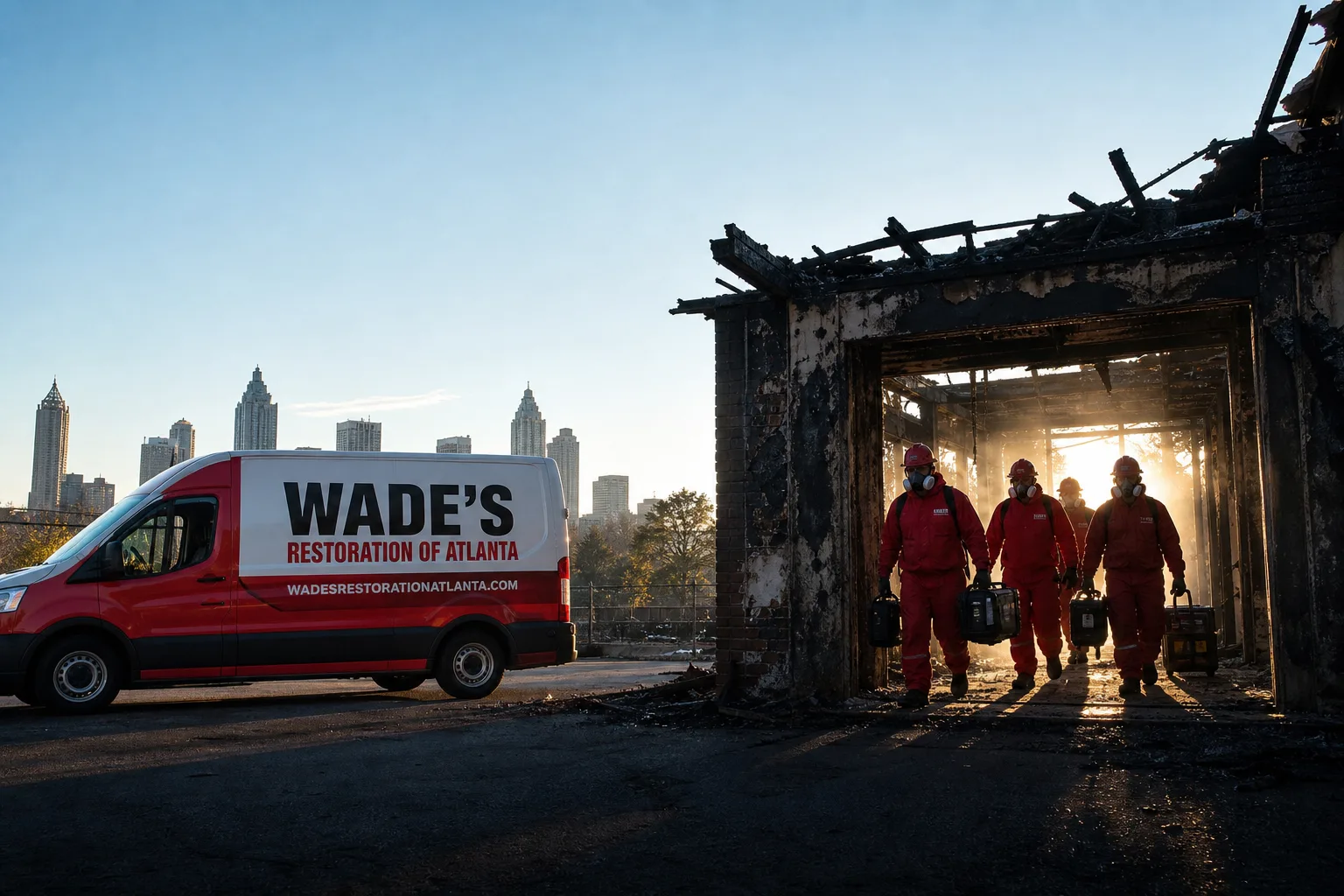
Fast, Reliable Mold Remediation Across College Park
If you’ve found mold in your College Park home or you’re smelling that musty odor that won’t go away, here’s what you need to know: mold remediation in College Park typically runs $1,800 to $6,500 depending on how far the colony has spread, and Wade’s crew can be at your door within the hour for an assessment. We’ve been working in College Park long enough to know that the homes along the 30337 flight path have their own set of mold problems, and that a sealed FAA noise-abatement envelope can hide moisture nobody sees until it’s too late. Call Wade at (888) 690-3757 and he’ll tell you straight what you’re dealing with, not what some national chain’s script says you should hear.
The thing about mold in College Park is that it doesn’t wait. Our humid subtropical summers push humidity through crawl spaces and attics fast, and once moisture gets behind a wall, colonization starts within 24 to 48 hours. Wade’s Restoration of Atlanta has been answering calls from College Park homeowners since 2007, and Wade himself still picks up the phone. Not a call center. Not a voicemail. The man whose name is on the truck.
Why Wade’s Restoration of Atlanta Is College Park’s Preferred Mold Remediation Company
Homeowners in College Park have been burned by the national franchises. Somebody quotes one number on the phone, then a different crew shows up with a different number and a binder full of fine print. Wade does not work that way. He publishes his name and address, he answers his own phone, and he will run into you again at the Kroger on Old National Highway. That is the oldest accountability mechanism there is, and it matters more than any advertised guarantee.
Wade’s crew works in College Park every week, from the Victorian homes in the historic district to the mid-century ranches off Virginia Avenue. We know the housing stock. We know the way a 1920s Craftsman with original plaster walls behaves differently from a 1950s ranch on a slab. And we know the FAA noise-abatement homes along the flight path, because we’ve opened enough of those walls to understand exactly what trapped humidity does behind a sealed building envelope.
Every mold job in College Park comes with the 90-Day Done Right Promise in writing. If it’s not done right, Wade makes it right. One call brings him back. That promise covers every job, and nobody has to remind us about it because it’s stamped on the contract before we start.
Our Mold Remediation Services in College Park
Mold Inspection & Testing
Before any remediation starts, you need to know what you’re actually dealing with. Wade’s crew does a full moisture mapping and air quality assessment, taking readings in every room, every wall cavity, and every crawl space. In College Park’s FAA-sealed homes, we pay special attention to wall cavities and attic spaces that never show visible mold but hold persistent humidity. We hand you the full moisture log, every reading from every day, so you know exactly what we found and what we did about it.
Mold Removal
Mold removal in College Park is not a spray-and-walk job. We contain the affected area with negative air pressure, remove contaminated materials down to the structure, and treat the remaining surfaces with an EPA-registered antimicrobial. In older historic district homes with original plaster and lath, removal often means careful sectioning to preserve what’s salvageable while eliminating the colony entirely. The goal is not just dead mold. It’s a home that stops growing mold.
Black Mold Remediation
Black mold, or Stachybotrys, gets a lot of attention and for good reason. It thrives on chronically wet cellulose, like drywall and wood framing, and College Park’s humidity gives it plenty of opportunity. When we find black mold in a College Park home, we treat it with full containment protocols, HEPA filtration, and post-remediation verification testing to confirm the spore counts are back to normal background levels. You get the documentation, not just a verbal assurance.
Air Quality Restoration
Mold spores are airborne, and even after the visible colony is gone, the air in your home can carry thousands of spores per cubic meter. Wade’s crew runs HEPA air scrubbers during and after remediation, including units from Dri-Eaz and B-Air positioned to capture spores before they spread to unaffected rooms. For College Park homeowners with respiratory sensitivities or compromised immune systems, we recommend post-remediation air sampling to confirm the indoor environment is genuinely clean, not just visually clean.
What happens when you call
- 1
A real person answersNo phone trees - you reach a local pro.
- 2
You get an upfront price rangeHonest numbers before anyone is dispatched.
- 3
A background-checked tech heads outLicensed & insured, dispatched right away.
- 4
You approve before work beginsNothing starts until you say go.
Trusted Brands We Service in College Park
Wade’s crew runs professional-grade equipment from Dri-Eaz, Phoenix, and XPOWER, the same gear you’d find on a commercial restoration job in the airport corridor. We stock replacement filters, HEPA cartridges, and dehumidifier parts locally, so we don’t have to wait on a shipment from a warehouse in another state when your College Park home needs service. When we set a Phoenix dehumidifier in your basement, it’s the right tool for the job, not a rental from a big-box store.
Common Mold Remediation Problems We See in College Park Homes
- Sealed FAA envelopes trapping moisture. Homes that went through Part 150 noise-abatement window and door replacement got tight building envelopes, which is great for sound but terrible for ventilation. We regularly open walls in 30337 homes and find mold colonies the homeowner never suspected, growing on the back side of drywall where humidity condenses against the sealed exterior.
- Historic district plaster and lath complications. The Victorian, Neoclassical, and Craftsman homes in the College Park Historic District often have original plaster walls with multiple layers of lead paint. Mold remediation in these homes requires lead-safe containment protocols and careful dust control. Not every crew is set up for that.
- Airport-area stormwater runoff into crawl spaces. The massive impervious surface around Hartsfield-Jackson accelerates runoff during Atlanta’s summer convective storms, pushing water into low-lying residential crawl spaces off Roosevelt Highway and Virginia Avenue. Homeowners mistake the rising humidity for a plumbing leak, then skip whole-crawl encapsulation and watch mold return months later.
- Deferred maintenance on airport-adjacent housing stock. Decades of economic pressure from the airport’s expanding footprint left many College Park homes with neglected gutters, failing vapor barriers, and sump pumps that gave out years ago. Mold is rarely the first problem. It’s the symptom of a moisture problem that some other crew never bothered to find.
Pricing for Mold Remediation in College Park, GA
What changes the price? How far the colony has spread, whether lead-paint containment applies, and how much of the affected material is plaster and lath versus modern drywall that cuts out faster. Wade gives you a written scope before work starts, not after. Call (888) 690-3757 for a free estimate, and if you already have a written estimate from another company, Wade will give you a free second opinion. No charge for that. And the Senior & Veteran 10% discount applies on every job, permanently.
We Also Serve Cities Near College Park
Wade’s crew handles mold remediation in College Park and the surrounding communities, including College Park neighbors like Hapeville, East Point, Riverdale, and Union City. Our Mold Remediation team covers the whole airport-adjacent corridor regularly, so scheduling is fast whether you’re off Riverdale Road or down toward Shannon Parkway.
Serving College Park, GA - Our Local Coverage Area
We’re based in the College Park area and know this community well. Use the map below to see our service coverage - if you’re nearby, we can almost certainly help.
FAQs - Mold Remediation in College Park
Why do homes in College Park’s 30337 flight-path zone have more hidden mold than homes in East Point or Hapeville?
The 30337 flight-path zone has a unique problem: FAA Part 150 noise-abatement programs sealed hundreds of homes with tight windows and doors, and that sealed envelope traps interior moisture inside wall cavities and attic spaces. East Point and Hapeville have their share of mold, but they don’t have the same concentration of sound-mitigated homes, so they see fewer of the hidden colonies that develop behind a sealed exterior. If your 30337 home smells musty but you see no mold, that’s likely what’s happening, and it’s exactly why Wade’s crew knows to check inside the walls, not just on them.
Do historic homes in the College Park Historic District require special mold remediation steps?
Yes. Homes built between the 1890s and 1930s in the College Park Historic District typically have original plaster and lath with multiple layers of lead paint, and mold remediation in those homes requires lead-safe containment protocols, careful dust control, and a different demolition approach than modern drywall removal. Wade’s crew is trained to preserve salvageable plaster while removing contaminated material, and we rebuild with vapor-permeable materials so the walls can breathe the way they were designed to. A generic remediation crew can do more damage to a historic home than the mold itself.
How quickly can mold start after a water event in College Park’s climate?
In College Park’s humid subtropical climate, mold colonization can begin within 24 to 48 hours of a water intrusion event, especially in summer when ambient humidity sits above 70%. That’s faster than in drier climates further north, and it’s why boilover, pipe bursts, and stormwater intrusion in College Park need moisture extraction and dehumidification fast. If you’ve had a water event and you’re just now smelling must, the mold has probably been growing for days or weeks already.
Can stormwater runoff from the airport’s impervious surfaces flood my crawl space and cause mold?
Yes. The vast amount of pavement around Hartsfield-Jackson accelerates stormwater runoff during Atlanta’s summer storms, and the low-lying residential areas off Roosevelt Highway and Virginia Avenue take the brunt of it. That water finds its way into crawl spaces and sits there, driving humidity up and creating ideal conditions for mold on floor joists and subflooring. If your crawl space smells musty after heavy rain, it’s not a plumbing leak. It’s runoff, and the fix is encapsulation and humidity control, not a plumber.
What should I do if my home received FAA noise-abatement sealing and now smells musty?
Call Wade at (888) 690-3757 and describe the smell. FAA-sealed homes trap humidity, and a musty odor usually means there’s a hidden colony behind drywall or in the attic that has been growing for months. The fix is not a dehumidifier from a hardware store; it’s a moisture mapping assessment, targeted opening of affected cavities, remediation under containment, and rebuilding with vapor-permeable materials so the envelope can finally release moisture. Wade has opened enough of these walls in 30337 to tell you within the first visit whether you have a real problem or just stale air.
Call Wade’s Restoration of Atlanta for Mold Remediation in College Park
If you’ve got mold, a musty smell, or a crawl space that never dries out, call (888) 690-3757. Wade answers his own phone, 24/7, and he’ll tell you straight whether you need full remediation or just a dehumidifier and some air movement. Estimates are free. The 90-Day Done Right Promise is in writing. And if another company already gave you a written estimate, bring it to Wade for a free second opinion. No trip charge inside our own county. That includes College Park, all of 30337, and everywhere else we work.
Written by Wade Ferris, Owner at Wade’s Restoration of Atlanta, serving College Park since 2007.