
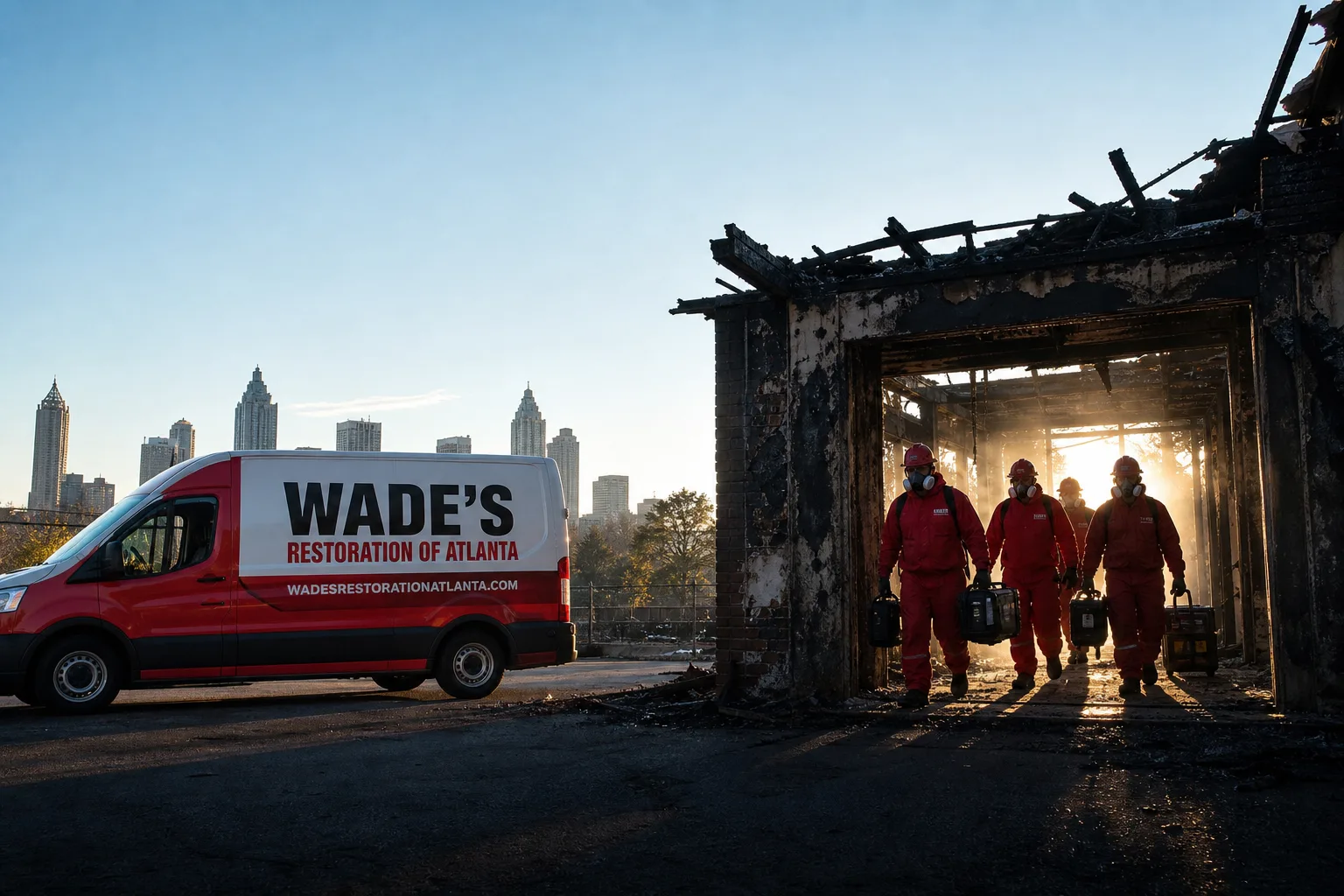
Fast, Reliable Mold Remediation Across Conyers
Mold in a Conyers home moves fast, especially after the kind of afternoon thunderstorms that roll through Rockdale County all summer long. Most of the mold problems we see in 30012 and 30013 aren’t surface-only. They’re tucked behind vinyl siding, inside wall cavities, or under floor joists in crawl spaces where the red clay holds moisture against the foundation. Wade’s Restoration of Atlanta has crews working in Conyers every week. Wade Ferris founded this company in 2007 and still answers his own phone. If you’ve found mold, or you smell that musty smell but can’t see anything, call (888) 690-3757 now. We’ll send someone who knows exactly what Conyers homes hide.
Why Conyers Homeowners Call Wade’s Restoration First
Wade Ferris built this company on a simple idea: put your name on the truck, publish your address, and answer the phone yourself. The homeowners we serve in Conyers, especially those in the 1988-2005 ranch and two-story neighborhoods off I-20, have been burned before. They’ve had a national chain quote one price over the phone and a different one at the door. That’s not how we work. Wade’s name is on every contract, and his cell number is on the paperwork. Ask anyone on your street. In this part of Rockdale County, word gets around fast when a contractor actually shows up and does what he said he’d do.
We’re not a franchise. We don’t rotate through fresh crews nobody’s ever seen before. When you call about mold in Conyers, you get a live person, and if it’s bad enough, Wade heads out himself. We carry IICRC, RIA, and IFA credentials, and we’re insured and bonded. But around here, the credential that matters most is showing up at 2 a.m. when your water heater lets go and mold has a 48-hour head start. That’s what we do.
Our Mold Remediation Services in Conyers
Mold Inspection & Testing
You can’t fix what you haven’t found, and in Conyers, the mold you can see is rarely the whole story. We start with moisture mapping around slab perimeters and through wall cavities. Homes along McDaniel Mill Road and in subdivisions near the Yellow River tributaries have a pattern we know well: water pools against settled slab edges, wicks into OSB sheathing, and mold grows behind intact vinyl siding. Our inspections include third-party lab air sampling when the scope calls for it, so you’re not just taking our word that the air is safe. You get documentation.
Mold Removal
Mold removal in Conyers means containment first. The last thing you want is airborne spores spreading to your living room while we’re tearing out drywall in the garage. We set containment barriers, run negative air pressure, and remove contaminated materials properly. After removal, we treat cavities with IICRC-approved antimicrobial agents. Then we dry everything to verified, documented moisture levels. Wade hands you the full moisture log at the end of every job. Almost nobody in this trade does that. We do because you should know what was actually done inside your walls.
Black Mold Remediation
Stachybotrys, what most Conyers homeowners just call black mold, is serious and needs to be handled with real containment and real protection. In the humid Georgia Piedmont, black mold takes hold fast in wall cavities and crawl spaces where wood never fully dries out. We treat it like a medical procedure: full containment, HEPA-filtered air scrubbing, proper disposal, and clearance testing by an independent lab. No shortcuts. No “just spray some bleach on it.” That’s how you get sick. That’s how the mold comes back.
Air Quality Restoration
When mold has been growing inside walls, the visible problem is gone long before the air is clean. Spores are microscopic and they travel. In Conyers homes, where summer humidity routinely tops 70%, interior air quality after mold removal depends on getting moisture down and keeping it down. We run professional-grade dehumidifiers from Dri-Eaz and XPOWER, alongside HEPA air scrubbers, until third-party air sampling comes back clean. You get the lab report. You know the air your family’s breathing is actually safe.
Crawl Space Treatment
Crawl spaces on red Georgia clay are a Conyers specialty of ours. The clay doesn’t absorb moisture; it sheds it. That water sits against your foundation and turns the crawl space into a mold incubator. We treat crawl spaces with antimicrobial applications, encapsulation when appropriate, and moisture control that addresses the actual problem: water sitting under your house. Not just spraying the joists. Fixing why the joists were wet in the first place.
Moisture & Humidity Control
Humidity in Rockdale County never really goes away. Even in a dry house, that moisture is outside pressing in. We install and configure dehumidification systems sized for the home, not the square footage on a spec sheet. For Conyers homeowners with persistent crawl space or basement dampness, especially in 1990s slab-on-grade properties where lot grading has settled, moisture control is the difference between doing mold remediation once and doing it every spring. We prefer once.
What happens when you call
- 1
A real person answersNo phone trees - you reach a local pro.
- 2
You get an upfront price rangeHonest numbers before anyone is dispatched.
- 3
A background-checked tech heads outLicensed & insured, dispatched right away.
- 4
You approve before work beginsNothing starts until you say go.
Trusted Brands We Service in Conyers
We don’t bring the cheapest equipment onto your property. Wade’s Restoration runs professional-grade Dri-Eaz dehumidifiers, XPOWER air movers, and B-Air scrubbers. These are the names restoration professionals trust because they work. We service all makes and models of dehumidification and air-filtration equipment that Conyers homeowners already own, and we keep the critical replacement parts and filters on the truck so we can fix most issues in one trip. If your old dehumidifier failed and the mold came back, we’ll get you set up with equipment that actually handles Georgia humidity.
Common Mold Remediation Problems We See in Conyers Homes
- Mold behind vinyl siding with no visible stain. Conyers’s 1988-2005 tract homes were built with vinyl siding over OSB sheathing. Storm water and slab-edge moisture wick into the OSB, and by the time you see anything on the drywall, the cavity is already colonized. We cut inspection openings and check every time.
- Slab foundation water intrusion repeating house to house. Whole subdivisions in east Conyers were graded identically by the same builder. When the red clay settles, it creates a shallow bowl that pushes stormwater into the slab-to-framing seam. If your neighbor has mold in the same wall you do, it’s not a coincidence. It’s the grading.
- High-humidity crawl spaces hiding mold in bottom plates. On red clay lots, water sits under raised homes and wicks up through floor framing. Standard air sampling alone misses this because spores spike only after rain events. We moisture-map the perimeter and inspect the subfloor cavities, not just the crawl space air.
- Persistent musty smell after a big thunderstorm. That smell in an east Conyers ranch is usually the first sign water pooled against a settled slab edge. By the time you smell it, mold has had days to move into the wall cavity. Call before it spreads to the living space.
Pricing for Mold Remediation in Conyers, GA
We Also Serve Cities Near Conyers
In addition to Mold Remediation in Conyers, our crews work in Stonecrest, Redan, Covington, and Snellville. The same red clay and the same storm patterns affect all of east metro Atlanta, so the problems and the fixes carry across the county lines. If you’re just outside Conyers in a slab ranch or a crawl space home, call us. We’re local, and we’ll be honest about what’s actually going on under your house.
Serving Conyers, GA - Our Local Coverage Area
We’re based in the Conyers area and know this community well. Use the map below to see our service coverage - if you’re nearby, we can almost certainly help.
FAQs - Mold Remediation in Conyers
Why does mold keep coming back in my 1990s Conyers slab foundation home even after I scrub it?
Because the mold isn’t on the surface; it’s inside the wall cavity, fed by moisture wicking into the bottom plates from settled slab edges. In Conyers’s 1990s tract homes, vinyl siding over OSB sheathing hides the real colony. Scrubbing the drywall removes the visible growth, but the OSB behind it stays wet, especially during Rockdale County’s humid summers. The mold regrows within weeks. You need the wall opened, the cavity inspected, the source of moisture fixed, and the framing treated with antimicrobial agents. That’s the only way it stops. Call (888) 690-3757 for an inspection that actually finds the source.
How does Rockdale County’s high humidity make mold remediation different in Conyers?
High humidity means materials dry slower, and mold spreads faster while drying is happening. In Conyers, summer relative humidity sits above 70% most days. That means a standard remediation that would work in a drier climate fails here unless the drying equipment is sized correctly and monitored daily. Wade takes moisture readings every single day and adjusts the equipment accordingly. At the end of the job, you get the full log. Most companies in this trade don’t do that. It matters in Rockdale County, where humidity never gives you a break. Call (888) 690-3757 to talk about your specific situation.
After a heavy thunderstorm, I noticed a musty smell in my east Conyers ranch but no visible water. Should I worry?
Yes, and you should act fast. That musty smell is a classic sign of water pooling against a settled slab edge and wicking into the wall framing. The red Georgia clay around east Conyers homes sheds stormwater, pushing it directly against the slab-to-framing seam. By the time you smell it, mold is already active inside the wall cavity, feeding on OSB sheathing and bottom plates. No visible water is common, because it’s all behind the vinyl siding. Get a moisture inspection before it spreads. Call (888) 690-3757 and Wade will head out.
Can you treat mold under my Conyers home without tearing out the whole crawl space?
In most cases, yes. We treat crawl space mold with containment, antimicrobial application to the affected framing, and moisture correction that addresses the red clay drainage issue. Full encapsulation is only necessary when the crawl space can’t be kept dry any other way. We’ll crawl under there, show you photos, and give you a written scope before any work starts. You’ll see exactly what needs to be done and why. No overscoping. No unnecessary tear-outs. Call (888) 690-3757 and we’ll take a look.
What’s the fastest way to know if my air quality is safe after mold removal in Conyers?
Third-party lab air sampling. Not our own in-house reading, not an anecdotal “smells fine now.” Independent lab analysis confirms whether spore counts are within acceptable ranges. We coordinate the sampling with a third-party lab unaffiliated with us, so the results are legitimate and you can trust them. We won’t sign off on a Conyers mold job until the air sample comes back clean. That’s the standard. Call (888) 690-3757 if you’ve had mold removed and want confirmation your home is actually safe to breathe in.
What Conyers Homeowners Need to Understand About Red Clay and Mold
Conyers sits on expansive red Georgia clay. It’s not a neutral surface; it’s a water delivery system. When it rains hard, which happens often here in the Piedmont, that clay sheds water instead of absorbing it. The runoff pools against your foundation. In the 1990s subdivisions of 30012 and 30013, where every lot was graded identically by the same builder, the clay settles over 20 to 30 years and forms a shallow slope running straight toward the slab. That’s why mold problems repeat house after house on the same street after every heavy thunderstorm. If your neighbor on McDaniel Mill Road has mold behind the same wall you do, it’s not bad luck. It’s the grading, the clay, and the OSB sheathing doing exactly what they do when water gets behind vinyl siding. Knowing that is half the fix. We handle the other half.
One Trip, Done Right
Last August, after a heavy thunderstorm drenched the McDaniel Mill Road area, our crew responded to two homes on the same street with near-identical water intrusion. Water had pooled against settled slab edges, wicked into OSB sheathing, and by the time we cut inspection openings, Stachybotrys colonies had spread 18 inches up the stud bay behind intact vinyl siding. Using Dri-Eaz dehumidifiers and injecting an IICRC-approved antimicrobial into the wall cavities, we brought both homes to post-remediation clearance in a single trip. Both homeowners got cavity-dry readings and a positive air sample from a third-party lab. The point isn’t just that we fixed it. The point is that we understood what Conyers construction hides, and we went straight to it instead of making two homeowners live with mold for an extra week. That’s the difference between knowing mold and knowing Conyers.
Call Wade’s Restoration for Mold Remediation in Conyers
If you’ve got mold, or you think you might, don’t wait. Every day it spreads further into the framing. Call (888) 690-3757 and you’ll talk to a live person, not an answering service. We’ll schedule a free estimate, we’ll inspect the actual problem, and we’ll put a written scope in your hands before we start. Every mold job we do in Conyers carries our 90-Day Done Right Promise: if it’s not done right, we make it right, in writing. Wade Ferris has been doing this since 2007, and his name is on every contract. No trip charge inside our own county. Free second opinion on any written estimate. Ask anyone on your street. Then call.
Written by Wade Ferris, Owner at Wade’s Restoration, proud to serve Conyers and all of Rockdale County.