
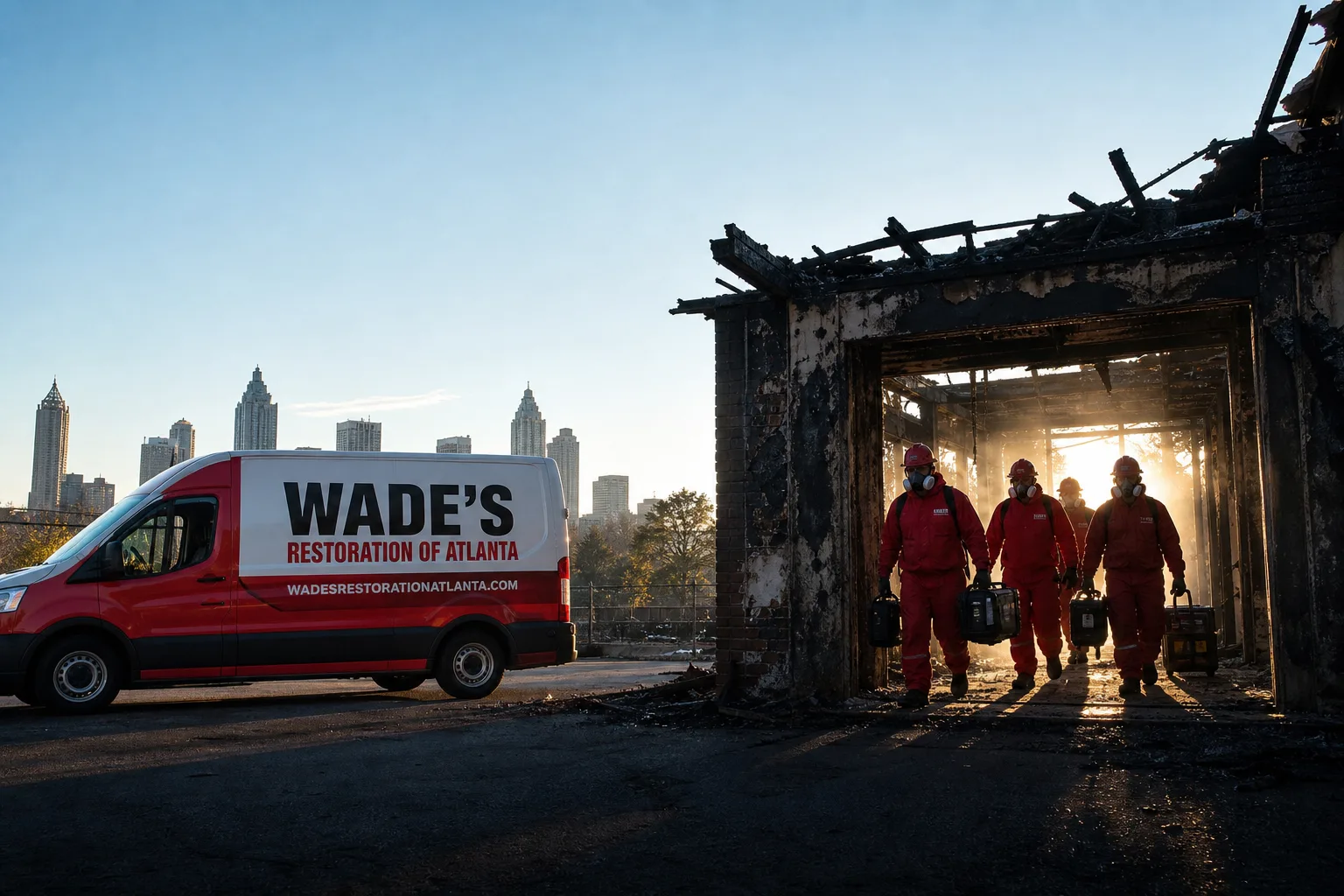
Fast, Reliable Mold Remediation Across Hapeville
Mold remediation in Hapeville typically runs $1,800-$6,500 depending on how far the colony has spread and whether crawl spaces or wall cavities are involved. Most jobs in Hapeville are done within 2-5 days once we start. If you’re seeing black spots on baseboards, smelling musty air in a hallway, or dealing with condensation that never dries out, call Wade’s Restoration of Atlanta at (888) 690-3757. Wade Ferris answers his own phone, and he’ll be the one walking your Hapeville property, not a crew you’ve never met.
We’ve worked Hapeville’s bungalows, worker cottages, and airport-adjacent properties long enough to know the difference between a surface mold issue and a moisture problem that’ll be back in three weeks. That’s the job: find the water, remove the mold, stop the cycle.
Why Wade’s Restoration of Atlanta Is Hapeville’s Preferred Mold Remediation Company
Hapeville isn’t a suburb where every house was built the same way. You’ve got 1920s craftsman bungalows with original plaster-and-lathe walls, crawl spaces that were never meant to handle Hartsfield-Jackson’s stormwater runoff, and newer builds that still sit on Georgia red clay that swells and shrinks with every season. Wade’s crew has been in and under enough of these homes to know what we’re looking at before we open a wall.
Wade Ferris founded this company in 2007 and put his name on the truck. His cell number is on his business card, and when you call the office at 2 a.m., he’s the one who picks up. That’s not a slogan. That’s how he’s run this outfit for nearly two decades. The 90-Day Done Right Promise is stamped in writing on every mold job: if the mold comes back or the moisture wasn’t actually stopped, Wade makes it right. Not a call center. Not a warranty department. Wade.
The people Wade sends to Hapeville are background-checked, uniformed, and trained to the IICRC standard. They run Dri-Eaz and Phoenix dehumidifiers, XPOWER air movers, and real containment, not a tarp and a box fan. And Wade hands you the full moisture log at the end of the job, every reading from day one to final clearance. Ask any restoration company in Hapeville for that. Most can’t hand over what they never recorded.
Our Mold Remediation Services in Hapeville
Mold Inspection & Testing
A proper mold inspection in Hapeville starts where the water starts. In this city, that’s often the crawl space, because airport stormwater runoff pushes groundwater against foundations faster than most homeowners expect. We inspect the crawl, the attic, the HVAC plenum, and every exterior wall penetration. We take moisture readings, document them, and if lab testing makes sense, we collect samples and send them out. You get the full picture before any remediation quote, because treating mold without knowing where the water’s coming from is just cleaning up after a leak that hasn’t stopped.
Mold Removal
Mold removal in Hapeville’s pre-1950 homes usually means cutting out plaster, removing contaminated insulation, and treating framing, not just wiping down surfaces. We set up IICRC-compliant containment so spores don’t spread to the rest of the house while we work. Then we physically remove the colonized material, HEPA-vacuum what remains, and run air scrubbers until clearance. The goal is a home that tests clean, not a house that smells better for a month.
Black Mold Remediation
Black mold, specifically Stachybotrys, shows up often in Hapeville crawl spaces and behind bathroom walls where slow leaks have gone unnoticed. It needs more than bleach. We isolate the affected area under negative air pressure, remove contaminated drywall and insulation, treat the framing with an antimicrobial, and dry to a verified standard. We don’t leave until moisture readings show the structure is actually dry, because black mold returns fast if it’s fed any residual moisture. Call (888) 690-3757 and Wade will walk you through what he’s seeing before any work begins.
Air Quality Restoration
After mold is removed, the air still carries spores and MVOCs, the compounds that give mold that musty smell. We run HEPA air scrubbers during and after remediation, clean the ductwork if it’s been contaminated, and take air samples before and after to confirm we hit clearance. For Hapeville homes near the airport, we also look at how outdoor humidity pushes indoor levels up, especially in crawl spaces and basements without proper vapor barriers. Air quality restoration is the final step that makes the house feel like yours again, not like a wet basement.
What happens when you call
- 1
A real person answersNo phone trees - you reach a local pro.
- 2
You get an upfront price rangeHonest numbers before anyone is dispatched.
- 3
A background-checked tech heads outLicensed & insured, dispatched right away.
- 4
You approve before work beginsNothing starts until you say go.
Trusted Brands We Service in Hapeville
We don’t bring homeowner-grade equipment into Hapeville homes. Our crews run Dri-Eaz and Phoenix dehumidifiers, XPOWER air movers, and B-Air filtration units, professional gear built for restoration work, not rental counter leftovers. We stock replacement filters, liners, and sealants so we’re not waiting on a parts order when your crawl space is still wet. Our IICRC-certified, RIA-affiliated, and IFA-recognized training means the equipment gets used correctly, and that matters more than the brand name. When Wade’s crew sets up containment in your Hapeville living room, it’s done right the first time.
Common Mold Remediation Problems We See in Hapeville Homes
- Crawl space mold from airport stormwater runoff. Hapeville sits low and flat right next to Hartsfield-Jackson, and the airport’s massive tarmac doesn’t absorb water, it sheds it. That runoff pushes into surrounding streets and yards, and hydrostatic pressure forces moisture through crawl space walls. We regularly find colonies under the vapor barrier, not on top of it.
- Wind-driven rain leaking at original window headers. Hapeville’s 1920s-1950s bungalows have plaster-and-lathe walls and window framing that was never sealed to modern standards. After a summer thunderstorm, water runs down inside the wall cavity and feeds hidden mold that never shows on the drywall surface. By the time you see a stain, the colony has been growing for weeks.
- Unlined crawl spaces with no vapor barrier. Many Hapeville worker cottages still have dirt-floor crawl spaces. Bare Georgia red clay releases moisture into the air under the house all summer, and mold colonizes floor joists and subflooring from above. A 12-mil reinforced liner and proper dehumidification fixes it, but only if the drainage outside is addressed too.
- Failed remediation that ignored the water source. We get called to Hapeville homes where another company sprayed, painted, and left. The mold was back in six weeks because nobody fixed the grading, the gutter, or the foundation crack feeding it. Wade’s crew traces the moisture first. Mold removal without moisture control is just postponing the same phone call.
Pricing for Mold Remediation in Hapeville, GA
Mold Remediation in Hapeville: What Makes This City Different
Here’s the thing nobody outside Hapeville writes about: this city shares ZIP code 30320 with Hartsfield-Jackson Atlanta International Airport, and that changes everything about how water behaves on your property. The airport’s impermeable tarmac concentrates stormwater runoff into surrounding streets and drainage, pushing groundwater against Hapeville foundations faster and with more force than any neighboring city. Your crawl space can be dry in the morning and wet by midnight after a hard summer storm. That’s not a generic Atlanta mold problem. That’s an airport-adjacent hydrology problem, and if the company you hire doesn’t understand it, they’ll treat the symptom and leave the source.
Properties along the north and east perimeter of the airport fence line have a failure mode we almost never see elsewhere: grading changes tied to successive airport expansion have redirected tarmac runoff into residential yards, so crawl spaces that stayed dry for forty years now flood regularly. Restoration techs in training manuals written for the broader Atlanta market never learn this. Wade’s crew learned it the hard way, on job sites you can see from the airport access road. We also coordinate with the airport authority and FAA where airspace adjacency rules create permitting hurdles, because delaying a drain line or vapor barrier fix while paperwork clears means the mold keeps spreading.
We Also Serve Cities Near Hapeville
Wade’s Restoration of Atlanta serves Mold Remediation in Hapeville and the surrounding communities, including College Park, East Point, Conley, and Riverdale. If you’re nearby and dealing with mold, moisture, or water damage, call (888) 690-3757. No trip charge inside our own county.
Serving Hapeville, GA - Our Local Coverage Area
We’re based in the Hapeville area and know this community well. Use the map below to see our service coverage - if you’re nearby, we can almost certainly help.
FAQs - Mold Remediation in Hapeville
Why does mold keep returning in my Hapeville crawl space even after remediation?
Mold returns because the water source wasn’t stopped. In Hapeville, that source is usually airport stormwater runoff raising the groundwater level against your foundation. If your crawl space was treated but the exterior drainage, grading, or vapor barrier wasn’t addressed, hydrostatic pressure will re-wet the soil and the mold colony will regrow within weeks. Call (888) 690-3757 and Wade will trace the moisture before recommending any treatment.
Do I need FAA coordination for mold remediation near the airport fence line in Hapeville?
Possibly, if the moisture source is on the exterior and the fix requires grading, drainage, or structural work near the airport boundary. Hapeville properties along the north and east fence line can fall under FAA airspace adjacency rules, which may slow down permits for exterior work. We’ve handled these cases and coordinate directly with the airport authority so the remediation schedule accounts for it.
How fast does mold spread in Hapeville’s older bungalows?
Fast. Hapeville’s 1920s-1950s homes have plaster-and-lathe walls and unlined crawl spaces that hold moisture, and once a water source is active, mold colonizes within 24-48 hours and spreads behind walls and under floors faster than in newer construction. The lack of modern vapor barriers in crawl spaces means a leak you can’t see is still feeding a colony you’ll smell within days.
What’s the most common hidden mold source in Hapeville homes after a storm?
Wind-driven rain entering at original window headers. Hapeville’s older bungalows have wood window framing that was never sealed to modern standards, and after a summer thunderstorm, water channels down inside the wall cavity and feeds mold that never shows on the drywall. By the time you see a stain, the colony has been growing for weeks. If you smell must after a storm, call (888) 690-3757 for an inspection.
Can mold remediation stop moisture from airport stormwater runoff in my Hapeville yard?
Mold remediation removes the mold. Moisture control stops the water. In Hapeville, where airport stormwater runoff pushes groundwater against foundations, you often need both: a vapor barrier and dehumidification inside the crawl, plus grading, drainage, or a sump system outside to redirect the runoff. Wade’s crew does both, and we’ll show you moisture readings proving the fix before we call the job done.
Call Wade’s Restoration of Atlanta for Mold Remediation in Hapeville
If you’ve got mold, must, or moisture in your Hapeville home, call (888) 690-3757 now. Wade Ferris answers his own phone, and he’ll tell you straight what he thinks before any crew shows up. Estimates are free. We don’t charge a trip fee inside our own county, and if you already have a written estimate from another company, Wade will give you a free second opinion. Ask anyone on your street. To wade is what you do through a flooded crawl space at two in the morning, and it happens to be his name.
Written by Wade Ferris, Owner at Wade’s Restoration of Atlanta, serving Hapeville and surrounding communities since 2007.